
March Fish of the Month: Bay Anchovy Anchoa mitchilli
Published: March 25, 2026
Dr. Geoffrey Smith
NWFSC Biology Instructor
Spring has arrived in Florida and for many fish species, the corresponding increase in temperature leads to greater overall activity, which requires more food to be consumed. But what do all those hungry fish eat? The answer for a large number of our local fish both large and small is the Bay Anchovy Anchoa mitchilli. In fact, the Bay Anchovy is one of the most important prey items for numerous fish species all along the Gulf and Atlantic coasts of the US and is a vital link in many ecosystems. This species, along with other anchovies and as juvenile sardines, herrings, and menhaden, are what many anglers refer to as a “glass minnow”. The Bay Anchovy is a relatively small (up to 4 inches) and short-lived (2-3 years) schooling fish in the family Engraulidae (the anchovies). They grow rapidly and become mature within a few months of age, at around 1 inch in length. Overall they are relatively transparent with a tan to greenish back and silver stripe down their side (Figure 1). They are easily distinguished from other local species of anchovies by having an especially short snout (Figure 2). The common name refers to the fact that this species is typically found in bays and other estuarine environments. The genus name Anchoa is based on the Italian word for anchovy and the species name mitchelli is in honor of Dr. Samuel Latham Mitchill (1764-1831) who was a prominent American physician, naturalist, and US senator that conducted some early studies on the fishes of New York.
But what makes the Bay Anchovy such an important food source for so many fish? There are several factors that contribute to their importance. Probably the most obvious is that they are very abundant and widespread. Bay Anchovy are distributed from Maine southward along the Atlantic coast and all along the Gulf coast to the Yucatan Peninsula of Mexico (Figure 3). They commonly form very dense schools with tens of thousands of individuals in them (Figure 1). Their high abundance largely stems from their early maturity and extended spawning season. As mentioned previously, Bay Anchovy matures within a few months of hatching. They also spawn from May through September (5 months) on the northern end of their range and nearly year-round in southern Florida. Another key factor in their importance as a prey item for many fish species is their tolerance for a wide range of water conditions. They can tolerate a very wide range of salinities from nearly fresh water to fully marine waters, allowing them to travel far up tidal rivers and creeks, as well as being found in bays and ocean waters along the coast. This exposes them to numerous different predatory fish at different life stages from small juveniles all the way up to adults. A final key factor in their importance as a food source for many fishes is that Bay Anchovy are very energy dense. This means for their body size they transfer a large amount of stored chemical energy when they are consumed by larger organisms. Anchovies (Engraulidae) and a related family (Clupeidae: sardines, herrings, menhaden, etc.) often have a very high lipid (oils and fat) content in their tissues, which often conveys much more energy than proteins and carbohydrates (sugars). And since Bay Anchovy mature early and reproduce throughout much of the year, they are also often full of energy-rich eggs when they are consumed (at least in females).
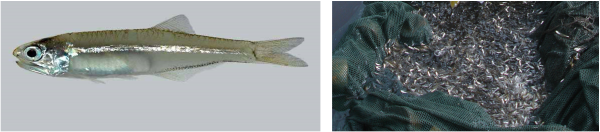
Figure 1: Adult Bay Anchovy on the left and large group of Bay Anchovy collected during standardized sampling of a restoration site in Tampa Bay, FL. Images from: Left – J. Van Tassell & D. Robertson, https://biogeodb.stri.si.edu/caribbean/en/pages; Right – Dr. Amanda Croteau, UWF
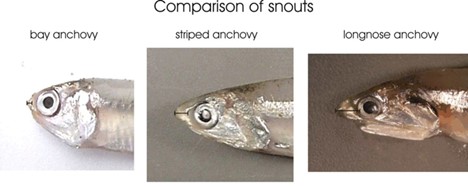
Figure 2: Comparison of snout length in several common anchovies in coastal waters of the Gulf of Mexico and US South Atlantic. The Bay Anchovy Anchoa mitchilli has a much shorter snout than other species such as the Striped Anchovy A. hepsetus or Dusky (aka Longnose) Anchovy A. lyolepis. Image from: https://txmarspecies.tamug.edu/.
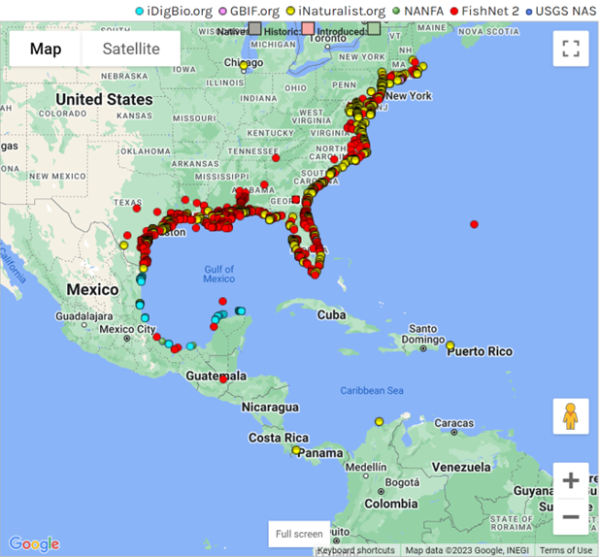
Figure 3: Map of Bay Anchovy distribution (http://fishmap.org/species/Bay-Anchovy.html).