
April Fish of the Month: Smooth Puffer Lagocephalus laevigatus
Published: April 9, 2026
Dr. Geoffrey Smith
NWFSC Biology Instructor
You’ve probably heard of the Easter Bunny and many associate rabbits with spring in general, but have you ever heard of a rabbitfish? There are in fact a number of fish referred to as rabbitfish or rabbit fish, depending on the species, but the one we’ll be covering this month is the Smooth Puffer Lagocephalus laevigatus. Like all puffers (Family Tetraodontidae), the Smooth Puffer has a set of four beak-like tooth plates (Tetraodontidae is essentially Greek for four teeth). The tooth plates generally resemble the teeth of a rabbit, hence the often used name rabbitfish (Figure 1). In the US, the Smooth Puffer is the species that is most often referred to as a rabbitfish, but it is sometimes used to refer to other member of the same genus, Lagocephalus, which comes from the Greek terms lago meaning “hare” and kephale meaning “head”, again playing on the superficial resemblance to a rabbit or hare. The species name laevigatus is Latin meaning “smooth” or “polished”, This species’ name and the common name Smooth Puffer refers to the fact that this species, when inflated, does not have any noticeable spines or texturing on its skin. The Smooth Puffer is found in both the Eastern and Western Atlantic Ocean, and in the Western Atlantic Ocean it is found in waters from New England southward to Argentina (Figure 2). In Florida, this species is typically found in nearshore and offshore areas, but on occasion, it is found in relatively high numbers in higher salinity inshore waters (bays and sounds).
Besides the rabbit-like dentition and head, the smooth puffer is a relatively narrow fish with a gray to dark blue back fading to gold or silver on the sides and white on the bottom of the fish (Figure 3). The Smooth Puffer is a relatively large puffer and commonly attains lengths of 1-2 feet with a maximum size of about 40 inches (almost 3.5 feet!). Puffers, as the name suggests have the ability to “puff up” or inflate as a defense mechanism by taking water into their highly expandable stomach when predators attempt to eat them. This allows some puffer species to increase in size by as much as double their normal size. Puffers will also inflate out of the water when they are captured by wading birds or humans handling them after being captured while fishing. In this case the puffers inflate with air rather than water. If the bird drops the puffer or the human releases it back into the water, the air in the stomach will cause the puffer to float on the surface. Some puffers have difficulty releasing all the air from their stomach. If you happen to catch a puffer, release it, and it is floating for more than around 30 seconds to a minute, you may need to assist it in releasing its trapped air. The easiest way to accomplish this is by holding your hand above the puffer or placing it in a landing net and submerging the puffer around 3-6 inches under the water. The extra pressure from the water will help to evacuate the air when the puffer tries to release it. This may take a minute or two because the puffer will often not immediately try to release the air as it thinks something is still trying to capture it. However, in most cases they will release the air and make a dash towards the bottom if they are only being touched on one side of the body.
The Smooth Puffer’s tooth plates allow it to consume a wide range of prey items, but they are particularly good at crushing and breaking open hard-shelled prey like crustaceans (crabs, shrimp, barnacles, etc.), mollusks (clams, oysters, snails, etc.), and echinoderms (sea stars, sand dollars, sea urchins, etc.). The cutting and crushing capabilities of these teeth can also produce a nasty bite to a human finger, similar to a large parrot, so all puffers should be handled with care.
Although, various species of puffers are considered to be edible (and delicacies by some), caution should be used in their preparation as they can house several potent neurotoxins in various parts of their body. In certain regions of Florida (Volusia, Brevard, Indian River, St. Lucie, and Martin Counties), puffers of the genus Sphoeroides are prohibited from harvest for consumption due to their link to saxitoxin poisoning (paralytic shellfish poisoning). The saxitoxin builds up in all parts of these puffers when they consume shellfish housing this toxin. Another common neurotoxin found in most puffer species, as well as several other fish with similar diets, is tetrodotoxin. This toxin is most common in the Indian and Pacific Oceans but can also be present in the Atlantic. Tetrodotoxin is typically concentrated in the skin and various internal organs, thus if properly prepared by an expert, the toxin can be avoided. So unless you’re an expert in preparing puffer fillets, it may be best to just release this species and avoid the potential debilitating risks that can range from temporary paralysis to death depending on the amount of toxin that is consumed. It doesn’t take much to cause death in humans, approximately 5-340 micrograms per kilogram of human weight (depending on the toxin). That is the size of a small grain of sand (or smaller) for an average human.
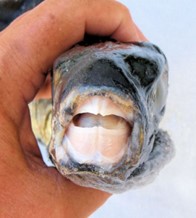
Figure 1: The tooth plates of the Ocean Puffer Lagocephalus lagocephalus, a close relative of the Smooth Puffer (Image from: https://mexican-fish.com/).
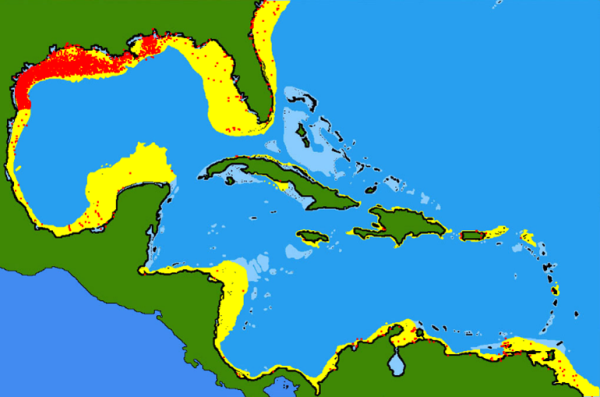
Figure 2: Distribution of Smooth Puffer in the Caribbean region of the Western Atlantic Ocean (Image from: https://biogeodb.stri.si.edu/caribbean/en/pages).
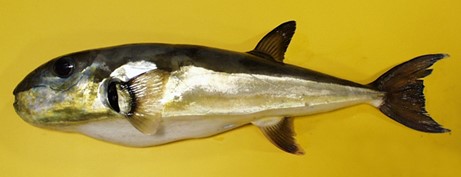
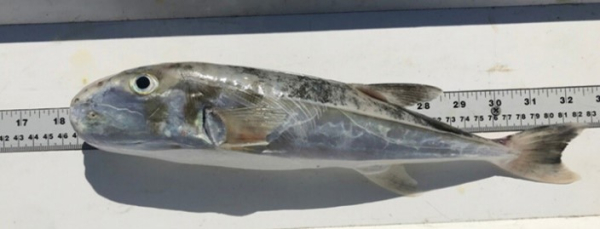
Figure 3: Top-a darker colored Smooth Puffer with a dark blue to black back, gold to bronze sides, and white bottom (Image from fishbase.org). Bottom-a lighter colored Smooth Puffer with a gray back, silvery sides, and white bottom (Image from https://txmarspecies.tamug.edu/).