
May Fish of the Month: Ladyfish Elops saurus
Published: June 1, 2026
Dr. Geoffrey Smith
NWFSC Biology Instructor
As we move into the summer months, one fish that becomes more abundant in our coastal waters is the Ladyfish Elops saurus. This is a wide-ranging species that is found from New England, south to Florida, and throughout the Gulf (Figure 1). The genus Elops is derived from the Greek éllops, which refers to a sea serpent or serpent like fish. Although it is not well documented, this may be in relation to this genera’s serpent like appearance, particularly the clearly defined, overlapping scales similar to those of a snake. The Ladyfish’s species name saurus is derived from the Greek sauros, which translates to lizard. A continuation of the reference to the overall reptile-like appearance of the Ladyfish: clearly defined overlapping scales, elongate and thin body, and the shape of the head and teeth.
The Ladyfish is relatively simple in terms of coloration. They are generally silver on the side, white on the bottom, and gray or tan/brown on the back (Figure 2). This is a classic counter shading coloration seen in many fish that typically inhabit open water areas. The dark back coloration breaks up their outline when looking down from above (camouflage against bird predators). While the light coloration on the bottom breaks up the outline when looking up from below (camouflage against many aquatic predators). Ladyfish are derived from one of the oldest lineages of modern bony fish and have several primitive features that are absent in most other modern fish. These include a gular plate (a flat bony structure between the lower jaw bones), ventrally (bottom) placed pectoral fins (most modern fish have them closer to the midline), and posteriorly (rear) placed pelvic fins (most moder fish have them placed more anterior/forward on the body).
Ladyfish are largely piscivorous, meaning they feed mostly on fish. However, they will consume a wide variety of foods. They often form large schools, particularly as they move out of juvenile habitats in tidal backwaters, to more open bays and coastal waters. Spawning occurs offshore and the larvae migrate to estuaries where they settle and grow in protected estuarine areas. The larvae of Ladyfish, and all of their relatives in the superorder Elopomorpha, has a relatively unique form and is referred to as a leptocephalus (derived from Greek words roughly translating to “thin head”). These larvae are relatively large, with clear, thin bodies and a very small head compared to their body size (Figure 2).
Ladyfish are a common targets of anglers. Despite generally being considered a poor food fish due to their oily meat and large number of small bones, the Ladyfish puts up a fun fight for anglers, and they are sometimes consumed (mostly as fish balls). They often make multiple high, jumps while being captured, earning them the nickname “Poor man’s Tarpon” (a larger relative known for its acrobatics and strong fights). Ladyfish are also commonly used as bait to capture other fishes, such as sharks, Red Drum, Tarpon, groupers, and snappers. Other common nicknames for this species include tenpounder (a reference to their strength not size, since IGFA world record weight is under 10 pounds) and skipjack (referring to the fact that this species regularly “skips” across the surface or jumps out of the water while feeding, not to be confused with the Skipjack Tuna or Skipjack Herring). In Florida state waters, this species falls into an unregulated category meaning that there are no set size limits and a daily harvest limit of 100 lbs.
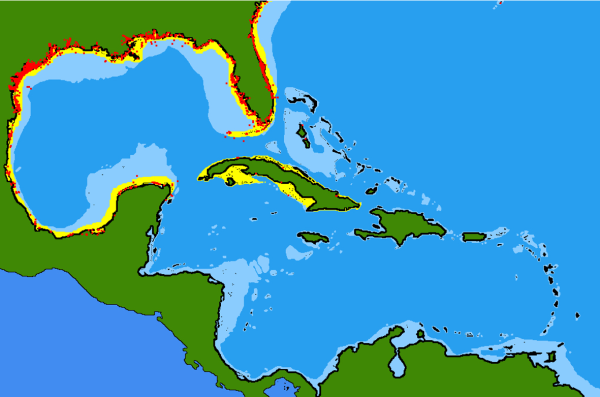
Figure 1: Ladyfish Hake distribution in the south Atlantic and Gulf waters. Image from: https://biogeodb.stri.si.edu/caribbean/.
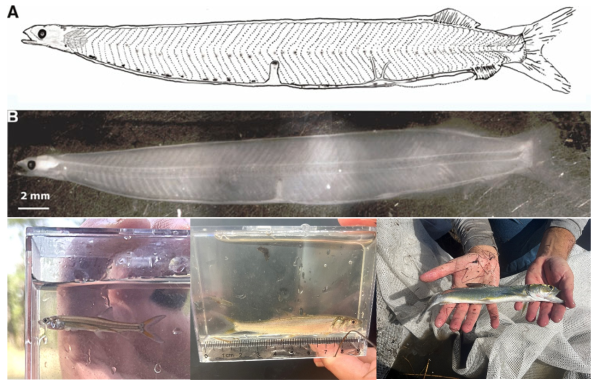
Figure 2: Ladyfish at different stages of their life: Top and Middle: leptocephalus larvae (from Machado et al. 2012); Bottom Left: post-larval Ladyfish, Bottom Middle: juvenile Ladyfish; Bottom Right: small adult Ladyfish (bottom images all from fish sampling in tidal tributaries of Santa Rosa Sound).